



If you feel like Sh1,000 barely buys you anything today, you’re not imagining it — you’re living inside one of the fastest erosions of purchasing power Kenya has seen in decades. And unless the structural pressures ease, 2026 will demand even more financial resilience.
But let’s confront the truth maturely:
The problem is not that the money “became worthless.”
The problem is that economic forces moved faster than most people adapted.
Below is an updated, data-based analysis for 2025 and projections for 2026.
How Much Value Sh1,000 Has Lost by 2025
Between 2013 and 2025, Sh1,000 has lost between 45%–60% of its real purchasing power depending on the household basket. The steepest damage happened between 2022–2024, when the shilling weakened sharply and food inflation hit record highs.
Key drivers that continued into 2025:
1. Inflation Still Above Target
Kenya’s inflation averaged 6.8–7.5% in 2024 (above CBK’s midpoint target of 5%).
Food inflation was persistently high, driven by:
- weaker currency
- high transport costs
- regional supply disruptions
2. Currency Depreciation Slowed, but the Damage Remains
After losing nearly 25–30% of its value between mid-2023 and early 2024, the shilling stabilized somewhat in 2025, trading between KES 142–150 per USD for most of the year.
Stabilizing is not the same as recovering.
Even with less volatility, the cost of imports remains high, putting pressure on absolutely everything — food, transport, utilities, medical supplies.
3. Higher Taxes & Cost of Doing Business
The Finance Acts of 2023, 2024, and 2025 introduced:
- Higher VAT on several items
- increased fuel taxes
- tax on digital services
- adjustments to PAYE
How the Purchasing Power of Sh1,000 Has Shifted: 2013 → 2025 → 2026 (Projection)
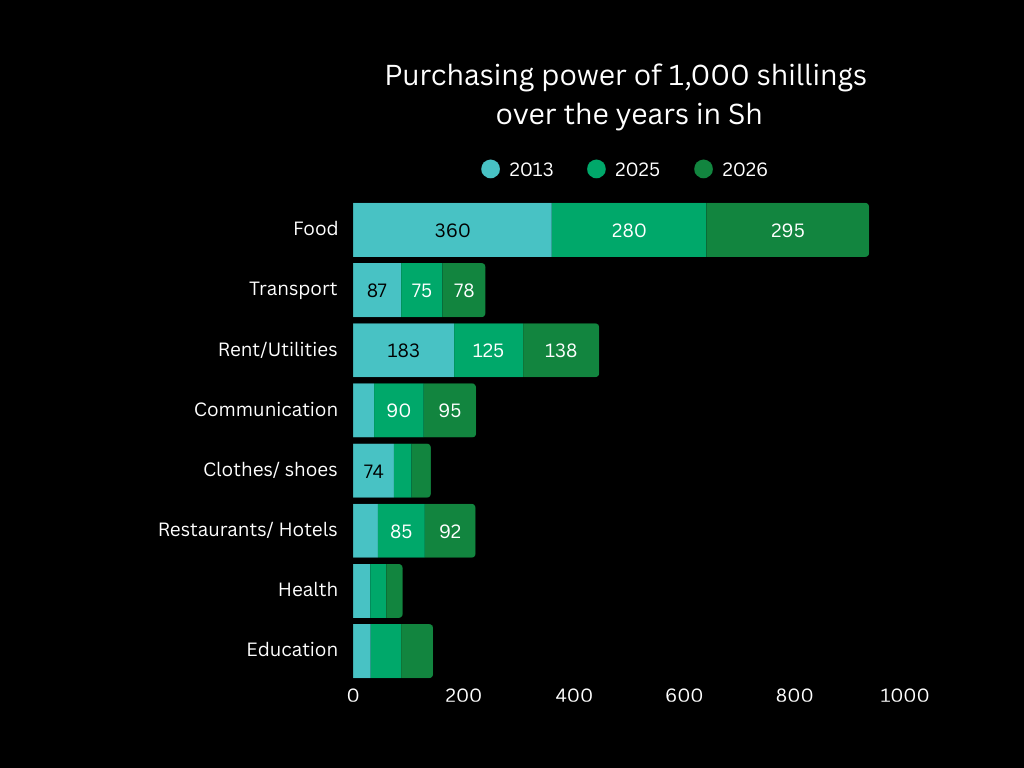
- Sh1,000 no longer plays the same role in household budgets.
- Biggest erosion: food, transport, rent, utilities.
- Biggest increase in spending share: communication & eating out.
- 2026 outlook: slowing inflation, but no real recovery of lost value.
Outlook para 2026: A Hard Truth and a Path Forward
The big question:
Will purchasing power stabilize in 2026?
Here is the realistic—not fanciful—scenario based on projections from the World Bank, IMF, and African Development Bank.
Inflation Expected to Ease (5.3%–6.0%)
Assuming better rainfall and stable FX, food prices may soften.
But easing inflation does not reverse past loss — it only slows the bleeding.
Shilling May Trade Between KES 145–155/USD
Mild depreciation expected due to:
- debt servicing
- global dollar strength
- pressure on imports
The decline is expected to be milder than in 2023–2024, but it will still hurt purchasing power.
GDP Growth Could Reach 5.4–5.8%
Driven by:
- finance + telecom
- agriculture recovery
- transport & services
But again:
GDP growth does not mean growth in citizens’ income.
Fiscal Pressure Will Remain High
Expect continued taxation and limited government space for subsidies.
Bottom Line for 2026
Sh1,000 won’t recover meaningfully.
But the speed of loss may finally slow.
This is the year households shift from:
“surviving inflation” to “hedging against currency risk.”
How Kenyans Can Adapt in 2026
1. Save in a stronger currency (USD or diversified baskets)
Saving only in KES is equivalent to bleeding slowly.
2. Increase income capacity, not just budgeting discipline
Skill-building > cost-cutting.
3. Avoid short-term digital loans at all costs
They destroy future purchasing power.
4. Invest in assets that rise with inflation
Examples:
- money market funds
- treasury bills
- dollar accounts
- agriculture-linked investments
5. Use financial tools that protect value
Fintechs that offer:
- Savings in dollars
- Stablecoin tracks
- Low-cost remittances
Become essentials, not luxuries.
Conclusion
The question for 2026 is not:
“How much is Sh1,000 worth?”
But:
“How do you ensure the value you produce is not destroyed by macroeconomics?”
The money won’t change.
The economy may not ease.
But your strategy can evolve — and that changes everything.